

The Science Behind Meat Tumbler Marination
The Science Behind Meat Tumbler Marination
Meat tumblers have become a cornerstone of modern meat processing, but the real value isn’t just speed or convenience. It’s the science happening inside the drum. When meat is tumbled under controlled mechanical action and vacuum pressure, physical and chemical changes occur at the protein level that directly impact flavor, texture, moisture retention, and yield.
Understanding the science behind meat tumbler marination helps processors make smarter decisions about equipment, cycle times, and product consistency. It also explains why vacuum meat tumblers outperform traditional soaking or static marination methods, especially when efficiency, repeatability, and quality control matter.
In this guide, we’ll break down how meat tumblers work, what happens inside the muscle fibers during tumbling, and why vacuum pressure plays such a critical role in modern meat processing. No lab jargon. Just practical science you can put to work on the production floor.
Key Takeaways in this Article
- Meat tumblers activate salt-soluble proteins, improving moisture retention, texture, yield, and flavor distribution.
- Vacuum pressure enhances performance by removing trapped air and allowing deeper, more uniform marinade penetration.
- Vacuum tumbling outperforms traditional soaking, delivering faster marination and consistent batch-to-batch results.
- Protein activation drives higher yield, reducing moisture loss, purge, and product variability.
- Equipment design directly impacts results, including vacuum strength, drum durability, motion control, sanitation, and mobility.
What Is a Meat Tumbler and Why Science Matters
A meat tumbler is a piece of processing equipment designed to apply controlled mechanical motion to meat products over a set period of time. As the drum rotates, the meat is gently lifted and massaged, allowing marinades, brines, and seasonings to interact more efficiently with the muscle tissue.
While meat tumblers are often associated with faster marination, the real advantage lies in how they influence protein behavior. The combination of tumbling action and, in many cases, vacuum pressure encourages salt-soluble proteins to move to the surface of the meat. Once there, these proteins help bind moisture, improve texture, and create a more uniform product.
This is where the science matters. Without understanding how tumbling affects muscle fibers and protein structure, processors are left guessing at cycle times and settings. When the science is applied correctly, meat tumblers become tools for consistency, yield control, and predictable results rather than trial and error.
How Meat Tumblers Work
At a basic level, meat tumblers work by combining motion, time, and controlled pressure to influence how meat responds to marinades and brines. Unlike static soaking, tumbling keeps the product in constant movement, which accelerates physical interaction between the meat and the solution.
To understand why this works so well, it helps to break the process into two core components.
The Tumbling Process
As the drum rotates, meat pieces are repeatedly lifted and gently dropped. This action creates a massaging effect that:
- Loosens muscle fibers without tearing them
- Helps distribute marinade evenly across the product
- Encourages salt-soluble proteins to migrate toward the surface
This mechanical energy is carefully controlled. Too aggressive, and the meat can be damaged. Too gentle, and protein extraction and binding are limited. Proper tumbling strikes a balance that improves texture while maintaining product integrity.
The Role of Vacuum Pressure
When tumbling is performed under vacuum, the process becomes significantly more efficient. Removing air from the drum lowers internal pressure, which allows trapped air within the muscle structure to escape. As that air is removed, space opens within the meat for marinade and moisture to move in.
Vacuum tumbling also reduces oxidation and surface foaming, both of which can interfere with protein binding. The result is faster marination, improved moisture retention, and more consistent results across batches.
The Science Behind Meat Tumbler Marination
Marination isn’t just about coating the surface of the meat. The real transformation happens when tumbling influences how muscle fibers and proteins behave.
Mechanical motion and vacuum pressure work together to change how meat absorbs, holds, and distributes moisture and flavor.
Understanding these changes explains why meat tumblers consistently outperform traditional marination methods.
Protein Structure and Muscle Fibers
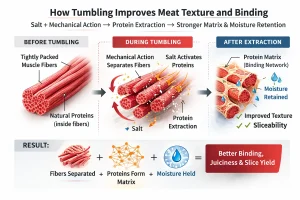
Muscle tissue is made up of tightly packed fibers held together by proteins. During tumbling, mechanical action gently separates these fibers without breaking them down. At the same time, salt in the marinade activates salt-soluble proteins within the meat.
As these proteins are extracted and move toward the surface, they form a sticky matrix that helps bind the product together. This process improves texture and plays a key role in moisture retention and sliceability once the product is cooked or processed further.
Moisture Retention and Yield
One of the most measurable benefits of meat tumbling is improved water-holding capacity. As salt-soluble proteins are activated, they gain the ability to bind water more effectively within the muscle structure.
This leads to:
- Reduced moisture loss during cooking
- Less purge in packaging
- Higher finished product yield
For processors, this means better weight retention and more consistent results from batch to batch.
Flavor Penetration at a Molecular Level
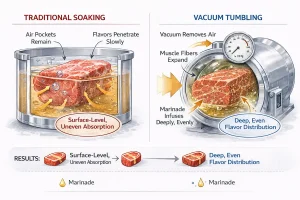
Vacuum tumbling doesn’t just move marinade around the outside of the meat. By removing air and opening space within the muscle fibers, it allows flavor compounds to penetrate more evenly throughout the product.
Compared to traditional soaking, tumbling achieves deeper flavor distribution in a fraction of the time. This not only improves taste but also ensures consistent seasoning across every piece, even in thicker cuts.
Vacuum Tumbling vs. Traditional Marination
Traditional marination methods rely on time and surface contact. Meat is soaked and left to absorb flavor slowly, often requiring extended refrigeration and manual handling. While this approach can work, it offers limited control over consistency and penetration.
Vacuum tumbling changes the equation by actively influencing how meat absorbs moisture and seasoning. The difference isn’t just speed — it’s how effectively the marinade interacts with the muscle structure.
Side-by-Side Comparison
| Process Factor | Vacuum Tumbling | Traditional Marination |
| Marination Time | Significantly reduced | Hours or overnight |
| Flavor Penetration | Deep and uniform | Mostly surface-level |
| Moisture Retention | High water-holding capacity | Greater moisture loss |
| Product Consistency | Repeatable, batch-to-batch | Variable results |
By combining motion, vacuum pressure, and controlled timing, vacuum meat tumblers deliver predictable outcomes that are difficult to achieve with static methods alone.
Why Vacuum Meat Tumblers Deliver More Consistent Results
Consistency is one of the biggest challenges in meat processing. Variations in marination time, seasoning distribution, and moisture retention can all lead to uneven products. Vacuum meat tumblers reduce that variability by creating a controlled environment where the same conditions are applied every cycle.
Because vacuum pressure removes air from the drum and the meat itself, marinades interact with muscle fibers in a more predictable way. Proteins are activated more evenly, moisture is retained more effectively, and flavor distribution remains consistent across batches.
From an operational standpoint, this consistency translates into:
- Fewer adjustments between runs
- Reduced rework and product waste
- More predictable processing timelines
Instead of relying on extended soak times or manual intervention, processors can dial in settings that deliver repeatable results day after day.
Applications Across Different Meat Products
The science behind meat tumbler marination applies across a wide range of products. While cycle times and settings may vary, the underlying principles of protein activation, moisture retention, and flavor distribution remain the same.
Whole Muscle Meats
For products like hams, roasts, and beef cuts, tumbling helps improve uniformity in both texture and seasoning. Vacuum pressure allows marinades to penetrate thicker muscles more effectively, reducing surface-heavy flavor and improving consistency from edge to center.
Poultry and Processed Proteins
In poultry, vacuum tumbling enhances moisture retention and helps maintain yield during cooking. For processed products, the extraction of salt-soluble proteins supports better binding and structure, contributing to a more uniform finished product.
Alternative and Plant-Based Proteins
Vacuum tumbling is also used in alternative protein processing, where consistency and moisture control are critical to consumer acceptance. Controlled tumbling helps distribute flavor and functional ingredients evenly, supporting better texture and repeatable results in emerging product categories.
Key Factors That Influence Marination Performance
While the science behind meat tumbler marination is consistent, results can vary depending on how the process is controlled. Several key variables determine how effectively proteins are activated and how evenly moisture and flavor are distributed.
The most influential factors include:
- Vacuum level: Higher vacuum levels remove more trapped air, allowing marinades to penetrate the muscle structure more efficiently. Lance tumblers are engineered to achieve one of the highest maximum vacuum pulls in the industry, helping open the pores of the meat for deeper, more consistent penetration.
- Tumbling time: Adequate cycle length ensures protein extraction and moisture binding without overworking the meat.
- Drum speed and motion: Controlled rotation provides effective massaging while protecting product integrity.
- Product temperature: Cooler temperatures support protein functionality and reduce the risk of quality loss.
- Equipment mobility and fit: Units mounted on heavy-duty wheels and designed to fit through standard 32-inch refrigeration doors (with larger models fitting through 60-inch doors) allow processors to roll the tumbler directly into a cooler to maintain optimal temperature control.
- Marinade composition: Salt concentration, viscosity, and ingredient balance all affect absorption and binding behavior.
Managing these variables allows processors to move from trial-and-error marination to predictable, repeatable performance.
Common Questions About Meat Tumblers
What to Look for in a Vacuum Meat Tumbler
Not all vacuum meat tumblers perform the same, and the science behind marination makes those differences matter. Equipment design directly affects how consistently proteins are activated, how evenly moisture is retained, and how repeatable results are from batch to batch.
When evaluating a vacuum meat tumbler, a few core factors have the greatest impact on performance.
- Vacuum strength and stability: Strong, consistent vacuum pull helps remove trapped air and promotes deeper marinade penetration throughout the meat.
- Drum construction and durability: A rigid drum with proper balance supports uniform tumbling action and long-term reliability under daily use. Heavy-duty welded shafts and reinforced frames reduce the risk of mechanical failure, helping maintain consistent performance over time.
- Controlled motion and speed: The ability to manage rotation speed helps protect product integrity while still achieving effective protein extraction.
- Ease of cleaning and maintenance: Sanitary design and accessible components support food safety compliance and reduce downtime between runs.
- Mobility and footprint: For many operations, the ability to move equipment easily or fit through standard doorways adds flexibility without sacrificing performance.
Choosing the right vacuum meat tumbler ensures the science behind marination works in your favor rather than becoming another variable to manage.
Final Takeaway: Science You Can Put to Work
The effectiveness of meat tumblers isn’t based on tradition or trial and error. It’s rooted in how mechanical motion, vacuum pressure, and protein behavior work together to improve moisture retention, flavor distribution, and product consistency.
By understanding the science behind meat tumbler marination, processors gain more control over their final product. Marination becomes faster, results become more predictable, and quality stays consistent from batch to batch. Whether the goal is improving yield, reducing rework, or delivering a uniform finished product, applying this science makes the difference.
When the right equipment and settings are in place, meat tumblers stop being just another machine on the floor and start becoming a reliable part of a well-controlled process.
Built to Last. Designed to Perform.
If you’re looking for a reliable product at a competitive price, please call us at 1 (800) 775-2623 or email us to learn more about our massage tumblers and get a quote!